Wix vs Angular: Which One Is Right for Your Business Website?
At ThemetechMount, we believe that choosing the right platform is just as important as choosing the right design. Every business has different needs, and there is no one-size-fits-all solution.
This guide offers a clear, unbiased Wix vs Angular comparison, helping you understand Wix vs Angular, see where each platform performs best, and choose the right option before investing time and money into your website.
How Wix Works, Step by Step
Wix is built to feel simple from the very first step. Here’s what actually happens when you use it:
- You sign up for a Wix account using your email
- You choose a template, or let Wix build a starting design for you
- You click on text and photos to change them to your own
- You drag sections around the page until it looks right
- You press “Publish,” and your site goes live on the internet
No part of this needs coding. Wix also stores your website on its own servers, so you never have to think about hosting, security, or backups. It’s all handled for you in the background.
How Angular Works, Step by Step
In the Wix vs Angular comparison, Angular works in a completely different way. It is not a drag-and-drop platform; instead, developers build websites by writing code. Here’s roughly what the Wix vs Angular development process looks like:
- A developer sets up an Angular project on their computer
- They write code to build each part of the website — buttons, pages, forms
- They connect the website to any data or tools it needs to use
- They test everything to make sure it works correctly
- They choose a hosting company and publish the finished site themselves
This process takes real coding knowledge. It also means someone has to manage hosting and keep the website updated after it’s live — that job doesn’t happen automatically like it does with Wix.
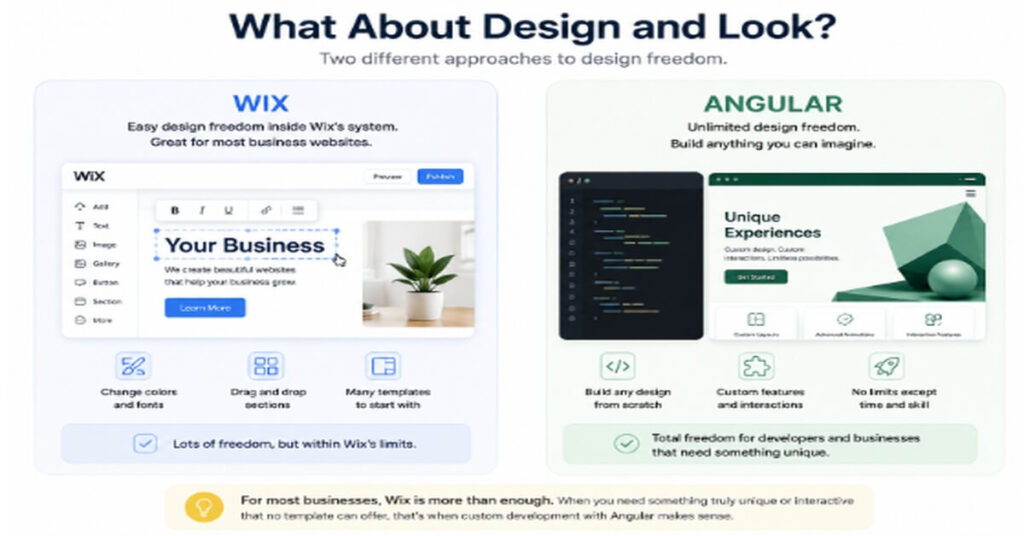
With Wix, you get a lot of design freedom. You can change colors, fonts, layouts, and add sections easily. But you’re still working inside Wix’s system — there are some things you simply can’t do, because the platform doesn’t allow it.
With Angular, there are no such limits. A developer can build literally any design or interaction you can imagine, because everything is created from scratch. The only limit is time and skill, not the platform itself.
For most business owners, Wix’s design options are more than enough. Very few businesses actually need something Wix can’t build. If you find yourself wishing for a very unusual animation, a totally custom layout, or an interactive tool nobody else has, that’s usually the moment a business starts looking toward custom development instead of a builder like Wix.
What About Website Speed?
A slow website annoys visitors and can hurt your Google ranking too. So how do Wix and Angular compare here?
Wix websites usually load at a good, normal speed right out of the box. But if you add too many apps, animations, or large images, your site can slow down — and you don’t have much control over fixing that yourself.
Angular websites can be extremely fast, because developers control every part of the code. But this only happens if the developer builds it carefully. A poorly built Angular site can be just as slow as a messy Wix site. Speed depends more on how something is built than which tool was used.
In everyday terms, this means Wix gives you “good enough” speed without any real effort, while Angular can be either excellent or disappointing, depending entirely on the skill of whoever builds it.
What About Google Search (SEO)?
SEO means how easily people can find your website on Google. This matters a lot for small businesses.
Wix already comes with the basic SEO tools built in — things like page titles, descriptions, and clean web addresses. You don’t need to set anything up manually; it mostly just works.
Angular can also perform very well on Google, but it needs extra setup to do so. Without that setup, Google may have a harder time reading and understanding your pages. This extra step is usually handled by a developer, not something a business owner can easily do alone
What About Safety and Updates?
Keeping a website safe from hackers and technical problems is important, but not something most business owners want to deal with themselves.
Wix takes care of this completely. Security patches, server maintenance, and backups are handled by Wix in the background, with nothing for you to manage.
With Angular, someone has to manage all of this — either you, an in-house developer, or a hired agency. It’s an ongoing job, not a one-time task, and it continues for as long as the website exists.
A Closer Look at Cost
Cost is often the deciding factor for small businesses, so let’s break it down in simple terms.
Wix charges a monthly fee. Depending on the plan, this covers hosting, templates, apps, and support. There’s no separate developer cost needed for a normal business website, which keeps the total cost low and predictable.
Angular itself is free to download and use — but that’s a bit misleading. Someone still has to write the code, and that usually means paying a developer. Depending on how complex the website is, this can cost a lot more than a Wix subscription, especially once you add hosting and ongoing maintenance on top.
In simple terms: Wix has one predictable bill. Angular has a bigger upfront cost, plus ongoing costs that can add up over time.
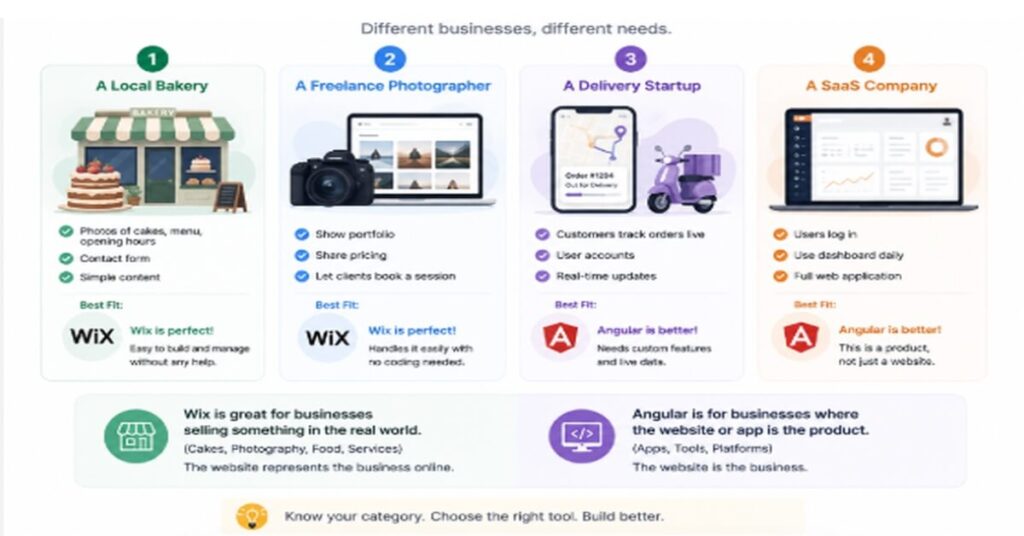
Sometimes it’s easier to understand this by looking at real situations, instead of just rules.
Example 1: A Local Bakery
A bakery wants a website with photos of their cakes, a menu, opening hours, and a contact form. This is simple content — Wix is a perfect fit, and the owner can manage it without any help.
Example 2: A Freelance Photographer
A photographer wants to show a portfolio, share pricing, and let clients book a session. Still fairly simple — Wix handles this easily, with no coding needed.
Example 3: A Delivery Startup
A startup wants customers to track their orders live, log into an account, and see real-time updates. This needs custom features and live data — a job better suited to Angular and a development team.
Example 4: A SaaS Company
A software company is building a tool where users log in and use a dashboard every day. This is a full web application, not a simple website — Angular is the right tool here.
Notice the pattern in these four examples.
The businesses that fit Wix are all selling something in the real world – cakes, photography sessions, food, services and the website’s job is simply to represent that business well online.
The businesses that need Angular are the ones where the website or app is the product itself, not just a representation of it. Once you spot which category your business falls into, the decision becomes much easier.
Common Mistakes to Avoid
A lot of businesses run into trouble not because they picked the “wrong” platform, but because they picked it for the wrong reasons. Here are the mistakes worth avoiding:
- Choosing Angular for a simple website just because it “sounds more advanced” — this usually wastes time and money on complexity you don’t need
- Choosing Wix for a complex app and hitting limits later — this often means rebuilding everything from scratch
- Not checking if your business truly needs custom features before spending on development
- Forgetting that Angular sites need ongoing maintenance and updates, not just a one-time build
- Picking a platform based on what a competitor uses, instead of what your own business actually needs
| What Matters | Wix | Angular |
| Do you need to code? | No | Yes |
| Time to build a site | A few hours or days | Weeks or months |
| Who handles hosting? | Wix does it for you | You (or a developer) manage it |
| How much can you customize? | Good, but has some limits | Almost unlimited |
| Best for | Small business websites | Big apps and complex tools |
| Cost | Simple monthly plan | Developer cost + hosting |
A Simple Way to Decide
Ask yourself one question:
Does your website just need to show information, or does it need to work like an app? If people will mostly read your pages, look at your services, or fill out a form, Wix is enough. If people need to log in, see live data, or use special tools inside your site, you probably need something more like Angular.
Most small businesses — shops, clinics, restaurants, service providers — fall into the first group. Big platforms and software products usually fall into the second.
Here’s another simple way to check: think about the last website you used that felt like an “app” — maybe your bank’s website, or a delivery tracking page. Did it need you to log in? Did it show information that changed in real time? That’s the kind of thing Angular is built for. Now think about the last small business website you visited — maybe a local restaurant or a dentist. It probably just had a menu, some photos, and a contact form. That’s exactly the kind of thing Wix is built for.
If you’re still not sure which group your business falls into, ask yourself a few more questions. Will customers ever need to create an account on your site? Will information on your site change every minute, based on live data? Will you need custom tools that don’t already exist anywhere else? If you answered “no” to all of these, Wix is almost certainly the right choice, and you can stop worrying about Angular altogether.
Pick Wix If…
- You want your site live fast
- You don’t have a developer
- Your site is mostly pages and content
- You want an easy monthly cost
- You want to make changes yourself, without help
- You don’t want to worry about hosting or security
Pick Angular If…
- You’re building an app, not just a site
- You have developers ready to help
- You need custom features nobody else has
- Your product will keep growing over time
- You need users to log in and see personal data
- You’re okay with a bigger upfront cost for long-term flexibility
Frequently Asked Questions
Is Wix easier to use than Angular?
Yes. Wix uses a visual drag-and-drop editor that allows beginners to build and manage websites without coding. Angular requires programming knowledge and is typically used by professional developers.
Which option is more affordable?
Wix generally has a lower upfront cost because it includes hosting, security, and maintenance in a monthly subscription. Angular itself is open source, but developing and maintaining an Angular website usually requires hiring experienced developers.
Which platform is better for SEO?
Both platforms can perform well in search engines. Wix includes built-in SEO tools that are easy to use, while Angular offers greater flexibility but requires proper development practices to ensure optimal SEO performance.
Is Angular the right choice for a small business?
Not always. If your business only needs a professional website with standard pages, a simpler website builder may be enough. Angular becomes more valuable when your project requires advanced functionality, custom features, or a scalable web application.
Can I switch from Wix to Angular later?
Yes, but it usually requires rebuilding the website. Since the two platforms work differently, content and design won’t transfer automatically. Planning ahead can save time and development costs.